
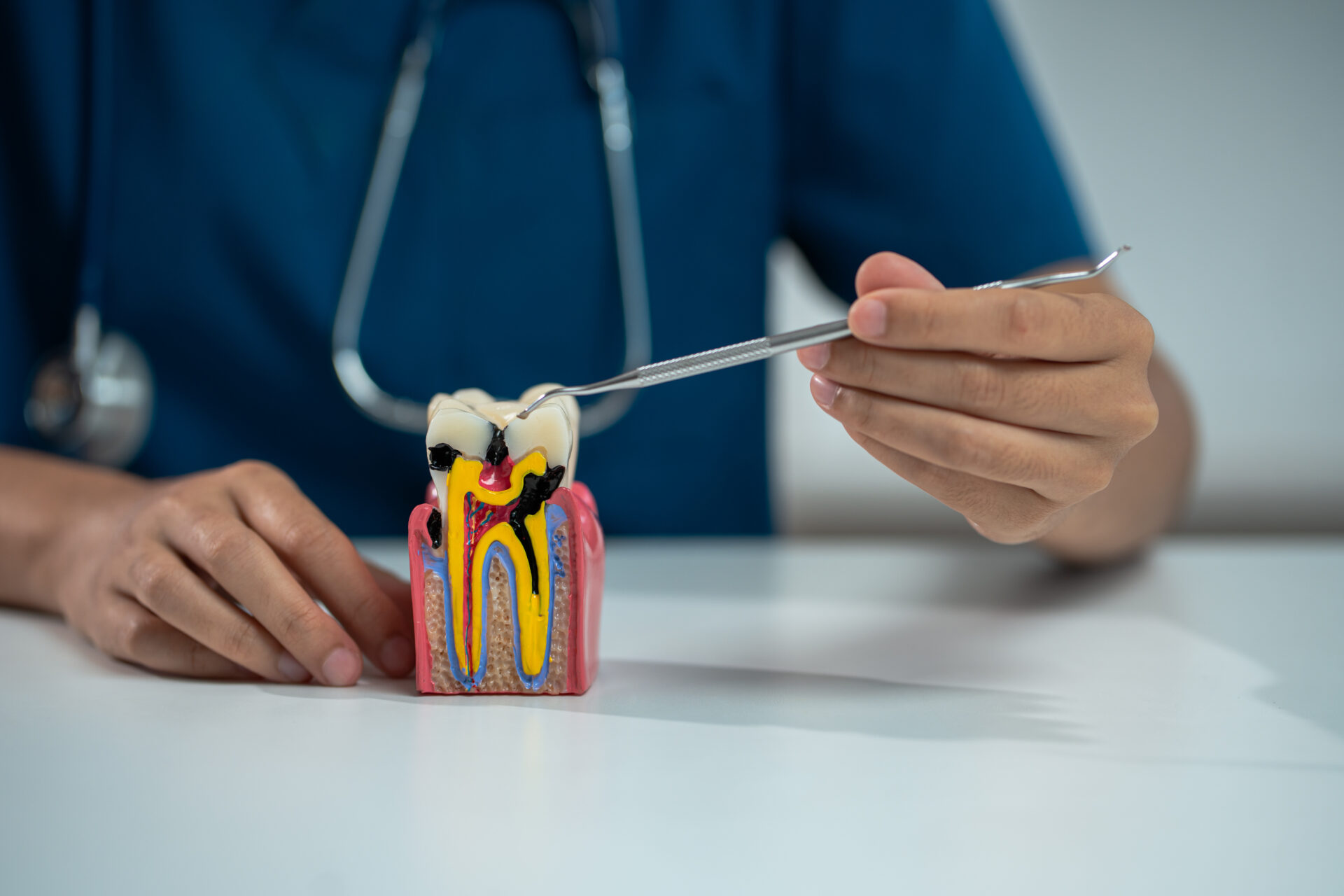
Root canal treatment on the Gold Coast
Root canal treatment clears infection or inflammation from inside a tooth so you can keep it. The tooth is numbed first, and most people feel pressure rather than pain.
Or call
(07) 5526 0111Open Monday to Friday
Signs you might need it
- Toothache that doesn't settle with pain relief
- Pain when you bite or chew
- Sensitivity to hot or cold that lingers after the food or drink has gone
- A small pimple on the gum next to a tooth
- Swelling in your gum or face
- A tooth that has darkened
Only an exam and X-rays can confirm it. Deep decay can also reach the nerve without much pain at all.
How root canal treatment is done
Exam and X-rays
We check the tooth and take X-rays to see how far the problem has spread, and confirm that root canal treatment is the right option.
Numbing and isolating
The area is numbed with local anaesthetic. A thin rubber sheet called a dental dam keeps the tooth clean and dry while we work.
Cleaning the canals
We make a small opening, remove the infected or inflamed pulp, then clean, shape and disinfect the canals. Front teeth usually have one canal; back teeth can have three or more.
Sealing the canals
The canals are filled and sealed to help stop reinfection, and the opening is closed with a filling.
Protecting the tooth
Back teeth usually need a crown afterwards, because a root-filled tooth can become brittle.
Your options
Root canal treatment
Keeps your natural tooth, so there's no gap to fill. A back tooth usually needs a crown afterwards.
Removing the tooth
Quicker and costs less on the day, but leaves a gap. Neighbouring teeth can drift into the space over time.
Replacing it later
If the tooth comes out, an implant, a bridge or a partial denture can fill the gap. Each adds to the cost of the extraction.
Good to know
How many visits?
Some teeth are treated in one visit and others need two or more, depending on the tooth and the infection.
Eat before you come
Your mouth may be numb for a few hours afterwards, so have something to eat beforehand.
Leaving it untreated
An infected pulp won't heal on its own. The infection can spread and form an abscess, and the tooth may eventually need to come out.
If the tooth darkens
A root-filled tooth can darken over time. Internal whitening can lighten it from the inside.
Risks to know about
- Some tenderness for a few days afterwards is common.
- A root-filled tooth can become brittle and crack, which is why a crown is often recommended.
- Occasionally the infection comes back and the tooth needs treating again or removing.
- Rarely, a fine instrument can break inside a narrow or curved canal. Your dentist will explain what that means for the tooth if it happens.
After treatment
- Wait for the numbness to wear off before eating.
- Use the pain relief your dentist suggests if the tooth is tender.
- Avoid chewing hard food on the tooth until it has its final filling or crown.
- Book the crown if one is recommended. Leaving a treated tooth without one for too long raises the chance of it breaking.
Call us if
- Pain or swelling gets worse after a few days instead of better
- The temporary filling comes out
- Your bite feels uneven
After hours, call 13 HEALTH on 13 43 25 84, or 000 if you have trouble breathing or swallowing.
What it costs
- 419[Fee]
Emergency nerve removal to ease pain
Extirpation of pulp or debridement of root canal(s), emergency or palliative
If the first visit is an emergency
- 415[Fee]
Cleaning and shaping, first canal
Complete chemo-mechanical preparation of root canal, one canal
- 416[Fee]
Cleaning and shaping, each extra canal
Complete chemo-mechanical preparation of root canal, each additional canal
- 417[Fee]
Sealing the root canal, first canal
Root canal obturation, one canal
- 418[Fee]
Sealing the root canal, each extra canal
Root canal obturation, each additional canal
- 455[Fee]
Extra cleaning and dressing visit
Additional visit for irrigation and/or dressing of the root canal system, per tooth
- 572[Fee]
Temporary filling
Provisional (intermediate/temporary) restoration, per tooth
Fees last reviewed [Fee review date]
Root canal fees depend on how many canals the tooth has and how many visits it takes. A crown, if needed, is quoted separately.
We accept all private health funds and claim on the spot with HICAPS.
We bulk bill eligible children under the Child Dental Benefits Schedule, so there's no out-of-pocket cost for covered services. Eligible children can receive up to $1,158 in benefits for basic dental services over two consecutive calendar years (2026 and 2027).
All fees and health fundsQuestions about root canal treatment
Is root canal treatment painful?
The tooth is numbed first, so most people feel pressure rather than pain. Some tenderness for a few days afterwards is common. Once the infection settles, the pain it caused should ease.
Why not just take the tooth out?
Removing it is an option. Keeping your own tooth means no gap to fill, and a back tooth that's removed is often replaced with an implant or bridge, which costs more. Your dentist will go through both with you.
Will I need a crown?
Usually for back teeth, the premolars and molars, because they take most of the force when you chew. A front tooth can sometimes be restored with a filling.
Do I need X-rays?
Yes. X-rays show the canals inside the tooth, which can't be seen in the mouth. Your dentist may take them before, during and after treatment.
Who does the treatment?
Our dentists provide root canal treatment. Some complex cases are referred to an endodontist, a dentist registered in the specialty of root canal treatment.
Will my health fund cover it?
Many funds class root canal treatment as major dental, which can have longer waiting periods. Give your fund the item numbers from your quote to check what you'll get back.
Related treatments
Further reading
Clinical content reviewed by [Clinical reviewer and registration number] on [Review date].
Root canal treatment at The Dental Studio
Who provides it here
[Days]
[Days]

[Days]
What we use
We use [Rotary or hand files, and whether a microscope is used].
Referred elsewhere
[Endodontist we refer complex cases to]
Or call
(07) 5526 0111Open Monday to Friday
After hours, call 13 HEALTH on 13 43 25 84, or 000 if you have trouble breathing or swallowing.